“Protection Dialogues: Body, Territory and Sovereignty”
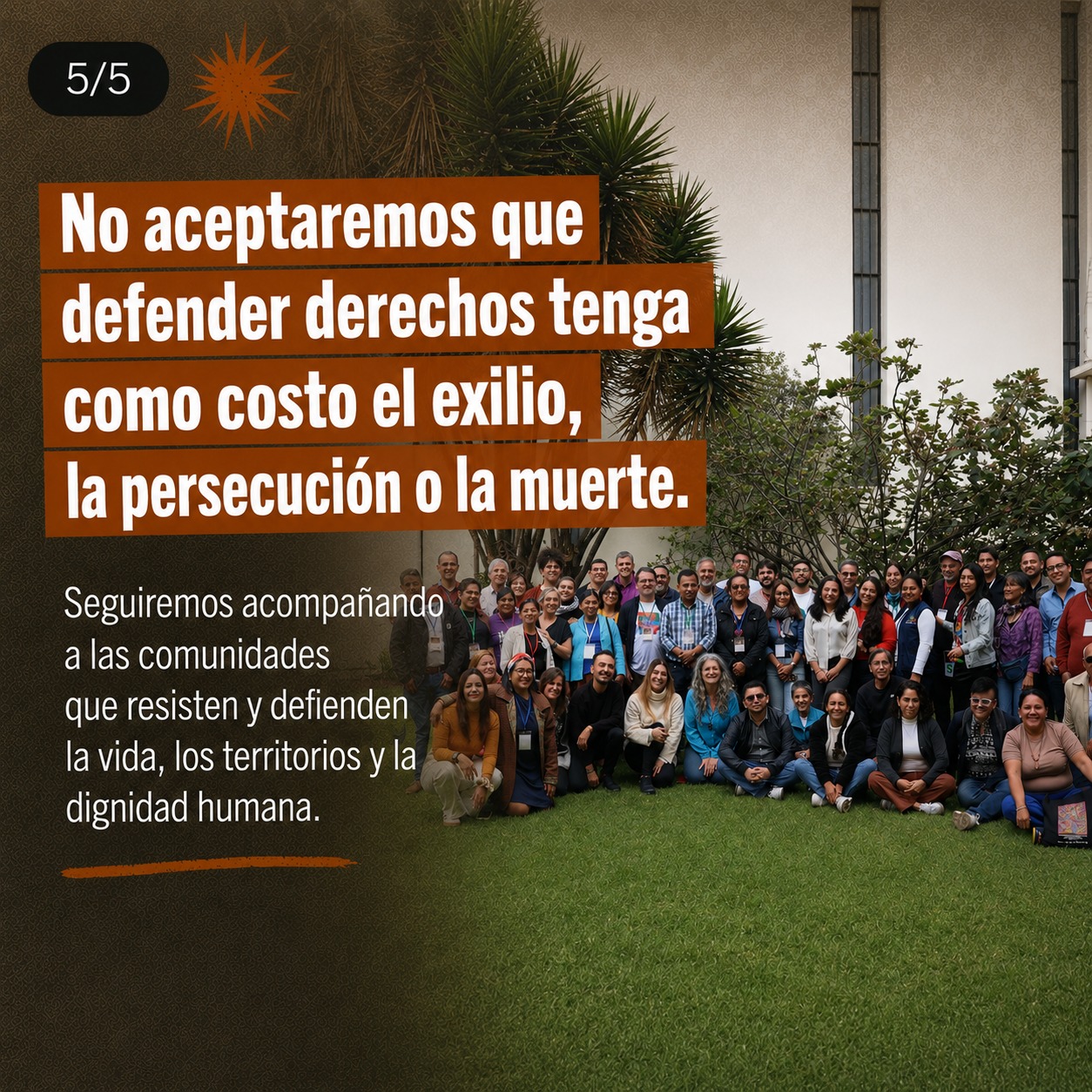
Joint Statement: In the face of authoritarianism and violence: we reaffirm our defence of human rights
- Human rights organisations, networks and human rights defenders, gathered at the “Protection Dialogues: Body, Territory and Sovereignty” as part of the Latin American Meeting, warn of the grave situation facing the region and the urgent need to strengthen protection for those who defend rights.
Latin America, 2 July 2026. The reality in our region is critical. We are undergoing a profound reconfiguration of power, characterised by the weakening and dismantling of democratic institutions and by a rollback in the guarantee of human rights. The convergence of interests between states’ sectors, extractive industries, tech giants and organised crime networks has facilitated the capture of institutions, deepened social polarisation and reduced the scope for people to conditions for participating in public decision-making without fear of reprisals.
Various forms of authoritarianism are advancing rapidly across Latin America. As a result, democratic consensus is eroding, while power is becoming increasingly concentrated in the hands of a few; interventionism and militarisation are being imposed upon our bodies and territories through the abusive use of force and the disproportionate application of states of emergency. At the same time, States are using legal frameworks to favour economic and corporate interests at the expense of our fundamental rights.
The advance of a development model based on extractivism is deepening social and territorial conflict in the region, while subordinating the protection of life, territories and the commons to short-term economic interests. The expansion of mining, energy, agro-industrial and infrastructure projects is, in many cases, being imposed without guaranteeing the individual and collective right to free, prior and informed consultation, and without the consent of the affected peoples and communities.
This imposition of dispossession and occupation is incompatible with local forms of organisation, indigenous systems of governance and visions for the future, and has disproportionate impacts on women, indigenous peoples, communities of African descent, peasant communities and LGBTIQ+ people, who face greater burdens of care, discrimination and violence.
In this context, defending human rights and the rights of nature in Latin America remains a high-risk activity. The region continues to be the deadliest in the world for those who take on this role. In 2025 alone, 275 human rights defenders were murdered, mainly in Colombia, followed by Mexico and Brazil, according to the international organisation Front Line Defenders.
The attacks we face reveal a network of violence that combines surveillance, smear campaigns, threats, harassment, criminalisation and judicial persecution, fuelled by the impunity with which states respond to the risks we face. Instead of guaranteeing our protection, laws and institutions are frequently used to restrict the work of those who defend the land, the territory, the environment and human rights. Added to this is the proliferation of disinformation campaigns and hate speech, pushed by state actors, corporations and other influential groups, which have a direct impact on our safety, integrity and legitimacy.
These attacks not only affect our bodies and our spirituality, but also pose risks of irreversible losses to biodiversity and the common goods. The pollution of water, air and soil; deforestation; the ecosystems degradation; species loss; the dispossession of territories; the forced displacement of communities; the livelihoods disruption; and the breakdown of community and cultural fabric – not only affect those of us who defend human rights and the environment, but also jeopardise the ecological balance and our future as humanity.
Faced with this situation, we issue the following call:
From this Latin American Meeting, we renew our continued commitment to supporting the communities and human rights defenders who are resisting in defence of their territories, strengthening regional coordination in the face of authoritarianism, violence, dispossession and the shrinking of civic space.
- We call on society in general to strengthen solidarity with and support for the individuals, organisations and communities defending human rights, territories and the commons, in the face of the rise of authoritarian and anti-rights tendencies in the region.
- We call on States to guarantee, in accordance with their international obligations, a safe and enabling environment for the exercise of the right to defend human rights; to respect, protect and guarantee the work of human rights defenders; to refrain from any action that obstructs or criminalises this work; and to repeal regulatory frameworks that restrict civic space and limit the exercise of this right.
- Institutions responsible for the protection of human rights defenders are encouraged to fully fulfil their mandate through territorial, intersectional, gender-sensitive and intercultural approaches, developed in consultation and ongoing dialogue with the individuals and communities affected.
- We call on the international community to uphold and strengthen political, technical and financial support, as well as monitoring of the situation of human rights defenders, in the face of the worsening risks and regressive trends facing the region.
We will not accept that persecution, criminalisation, exile or death should be the price for defending human rights, nor that the dismantling of the rule of law should be justified in the name of security or development. As long as guarantees remain under threat and communities continue to resist, we will continue to defend life, territories, democracy and human dignity.
Signatories
Argentina
Asamblea de Vecinos Autoconvocados de Uspallata – Agrupación de Presos Políticos por Defender el Agua de Mendoza
Bolivia
– Coordinadora Nacional en Defensa de Territorios Indígena Originarios Campesinos y Áreas Protegidas (CONTIOCAP)
– Asociación de Pueblos Indígena Originario Campesinos QHANA PUKARA KURMI Bolivia
– Centro de Documentación e Información Bolivia (CEDIB)
Brasil
– Justiça Global
– Movimento Nacional de Direitos Humanos – MNDH
– Sociedade Maranhense de Direitos Humanos – SMDH
Chile
– Fundación Enraizar
– Fundación Escazú Ahora Chile
– Fundación Protege Los Molles
Colombia
– Asociación Comunitaria de Víctimas de Defensa Derecho humano de Corozal
– Asociación de Cabildos Indígenas del Norte del Cauca
– Coordinación Colombia Europa Estados Unidos (CCEEU)
– Corporación Colectivo Ansur
– Corporación Jurídica Libertad
– Corporación Semillas de Agua
– Programa Somos Defensores (PSD)
– Comunidades Construyendo Paz en Colombia (CONPAZCOL)
– Corporación Claretiana
Ecuador
– Alianza de organizaciones por los Derechos Humanos – Ecuador
– Amazon Frontlines (Amazonic regions in en Ecuador, Colombia y Perú)
– Comité Permanente por la Defensa de los Derechos Humanos
– FIAN Ecuador
– Fundación Regional de Asesoría en Derechos Humanos (INREDH)
Guatemala
– Asociación Grupo Integral de Mujeres Sanjuaneras (AGIMS)
– Comité de Unidad Campesina (CUC)
– Unidad de Protección a Defensoras y Defensores de Derechos Humanos Guatemala (UDEFEGUA)
Honduras
– Alternativa de Reivindicación Comunitaria y Ambientalista de Honduras (ARCAH)
– Asociación de Comités Agroecológicos del sur de Honduras (ACESH)
Mexico
– Centro de Derechos Humanos Fray Bartolomé de Las Casas
– Movimiento por la defensa de los bosques y cuencas de agua de Tancitaro (Modebocum)
– Consorcio para el diálogo parlamentario y la equidad Oaxaca
– Espacio de Organizaciones de la Sociedad Civil para la Protección de Personas Defensoras de Derechos Humanos y Periodistas (Espacio OSC). Las organizaciones que integran el Espacio OSC: ARTICLE 19 México y Centroamérica; Casa del Migrante Saltillo; Centro de Derechos Humanos de la Montaña Tlachinollan; Centro de Derechos Humanos Zeferino Ladrillero (CDHZL); Centro Mexicano de Derecho Ambiental (CEMDA); Centro Nacional de Comunicación Social (Cencos); Comunicación e Información de la Mujer A.C. (CIMAC); Consorcio para el Diálogo Parlamentario y la Equidad Oaxaca (Consorcio Oaxaca); Instituto de Derecho Ambiental (IDEA); Iniciativa Sinaloa; Red Nacional de Organismos Civiles de Derechos Humanos Todos los Derechos para Todas, Todos y todes (RedTDT); SMR: Scalabrinianas, Misión con Migrantes y Refugiados; Servicios y Asesoría para la Paz (Serapaz), Proyecto de Derechos Económicos Sociales y Culturales (PRODESC). El Espacio OSC está acompañado por Brigadas Internacionales de Paz (PBI) – Proyecto México
Red Nacional de Organismos Civiles de Derechos Humanos “Todos los Derechos para Todas, Todos y Todes” (Red TDT)
Paraguay
– Asociación Callescuela
– Coordinadora de Derechos Humanos del Paraguay (Codehupy)
– Servicio Paz y Justicia – Paraguay (SERPAJ-PY)
Perú
– Red Muqui
International organisations standing in solidarity
– Movimiento Sueco por la Reconciliación, SweFOR – Programa Servicio de Paz
– Civil Rights Defenders
– Front Line Defenders (FLD)
– Global Witness
– Protección International- Mesoamerica
– Peace Brigades International (PBI)